
You do not need a costume to have a proper Carnival in St. Maarten. Standing on the road watching the bands come through is not a lesser version of the experience, it is its own thing: the music trucks passing close enough to feel, the costumes catching the afternoon light, food trucks behind you, and an island that has been building to this for weeks.
This guide is for spectators. If you want to be on the road in costume instead, our SXM Carnival masqueraders’ guide (coming soon) covers troupes, costumes, and where to get your hair, nails, and makeup done so you look your best on the road. And if the vocabulary is new, our Caribbean Carnival terms glossary is a good place to start.

SXM Carnival 2027 runs from Thursday 15 April to Monday 3 May 2027. The big road days land in the closing stretch, wrapped around the two public holidays: Friday 30 April and Saturday 1 May (Labour Day).
There are two parade days, and they do not follow the same route. This matters more than it sounds, because picking a spot based on the wrong day’s route means watching an empty street.
What follows are the routes the parades have usually taken. Individual streets can shift from one year to the next, and the police confirm the final route ahead of each parade. What does not change is the spine of it: the Pondfill and Front Street are part of the route every year, and both parades finish at the Village.
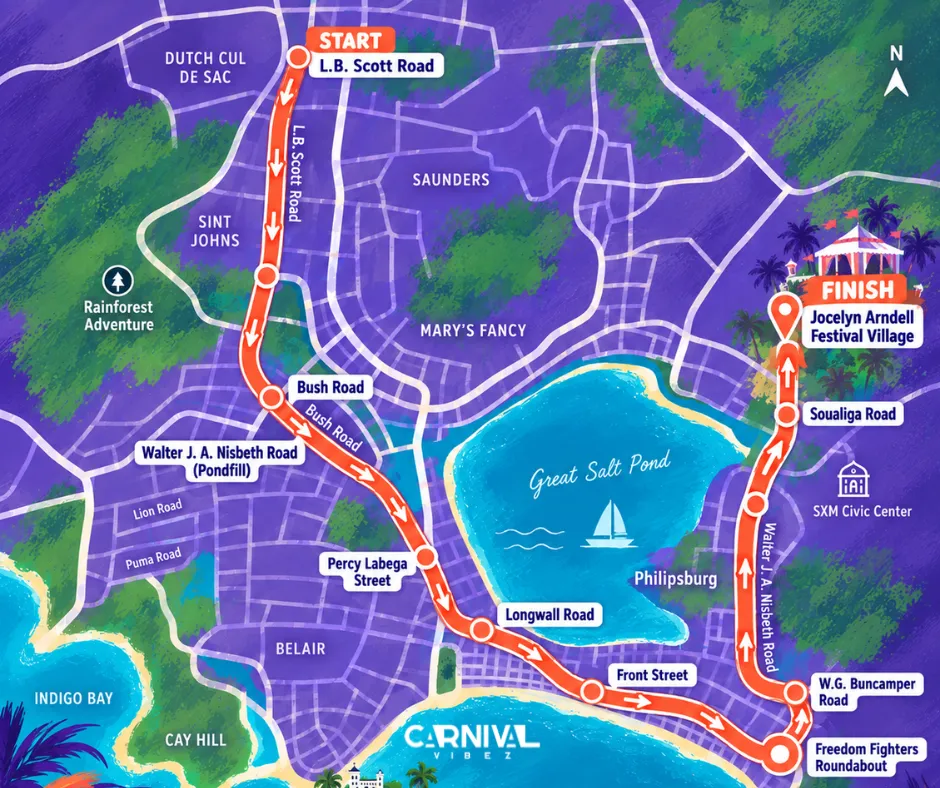
The longer of the two. It has historically started on L.B. Scott Road in Dutch Cul de Sac and come down Bush Road onto Walter J. Nisbeth Road, the stretch everyone on the island calls the Pondfill. From there it turns through Percy Labega Street and Longwall Road into Front Street, then heads out via W.G. Buncamper Road and the Freedom Fighters Roundabout, back onto Walter J. Nisbeth Road and Soualiga Road, finishing at the Jocelyn Arndell Festival Village.
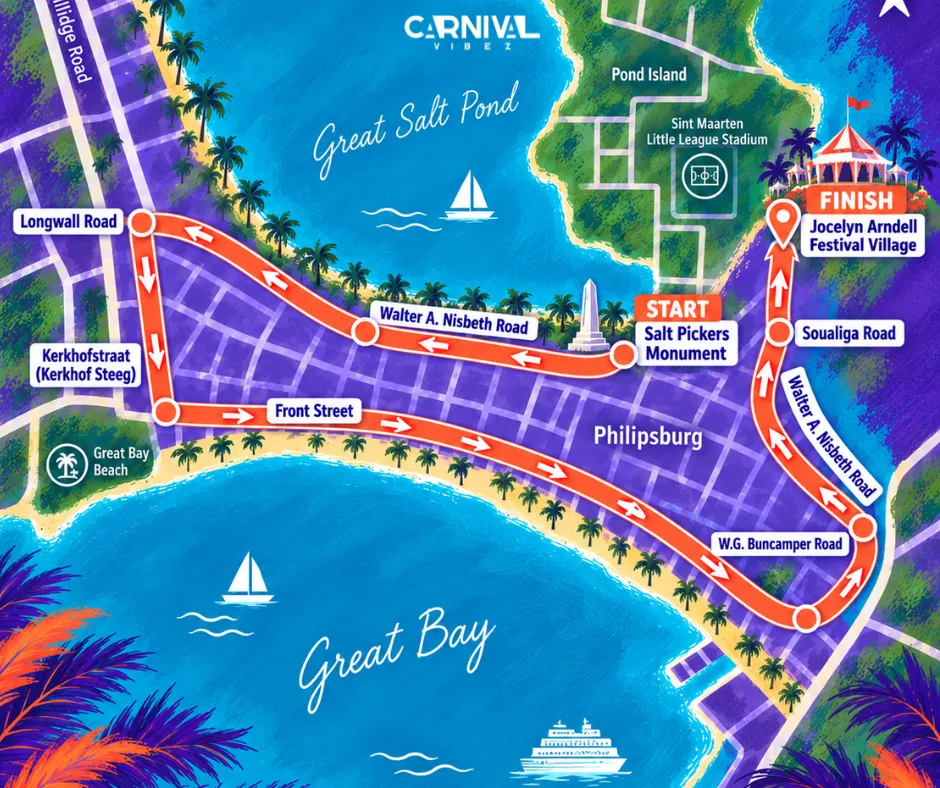
Shorter, and a different shape. It has usually started at the Salt Pickers Roundabout on Walter J. Nisbeth Road, then taken Longwall Road, Kerekhof Steeg, Front Street, and W.G. Buncamper Road, before rejoining Walter J. Nisbeth Road and finishing at the same Village.
So if you want to pick one spot and not think about it again, the Pondfill, Front Street, or the Village will serve you on either day.
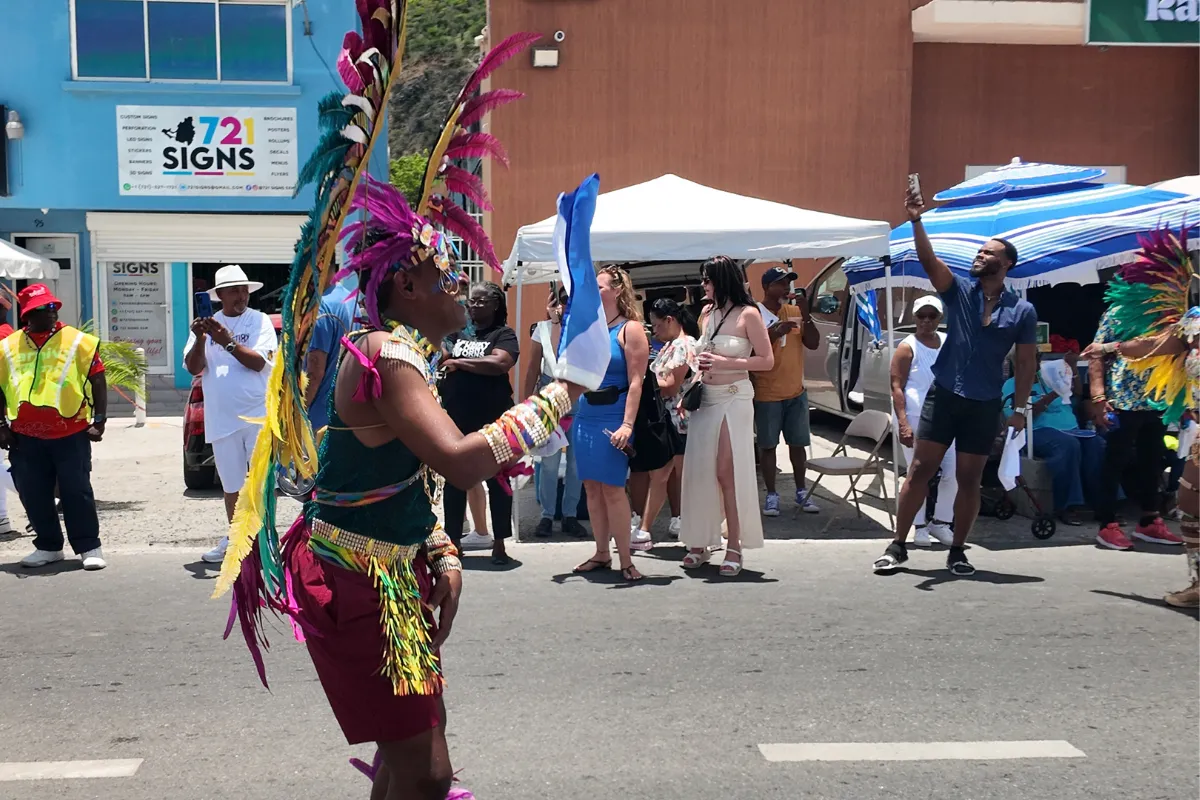
There is no paid or reserved seating for the parades. Nobody sells you a grandstand seat, and there is no ticketed viewing area. You find a spot on the road and you claim it. That is good news, because it means the best places to watch are free, but it also means turning up and expecting to buy your way into a good view will not work.
This is the one we would send most people to. It is a long stretch, which is the whole point: on a route where other sections get packed and you end up behind three rows of people, the Pondfill gives you room to find a clear patch and actually see the bands come through uninterrupted.
The other advantage is practical. Food trucks set up along the stretch, so you can grab something to eat and a drink between bands without giving up your spot or hiking into town to find food. On a parade day that runs for hours in the heat, that matters more than you would think before you are standing in it. If you want to know what to order, see our guide to must-try Caribbean Carnival foods.
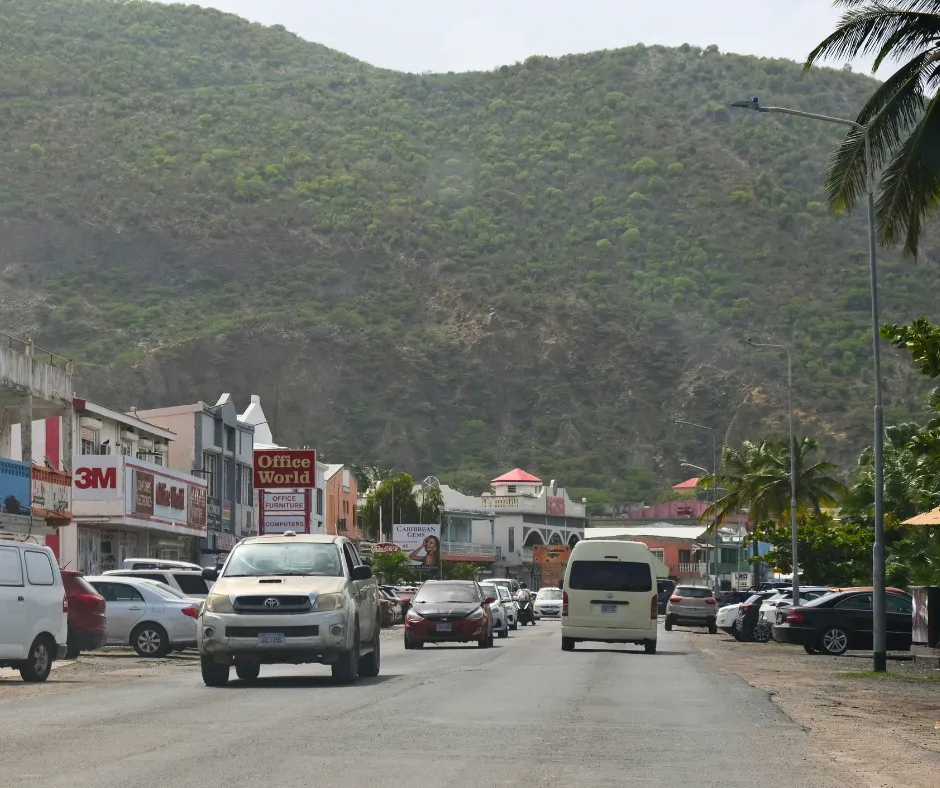
The other strong option, and the one to pick if you are staying in town. Front Street is narrower and more enclosed than the Pondfill, so the atmosphere is tighter and the music bounces off the buildings.
It is particularly good if you are staying at Holland House Beach Hotel, which sits directly on Front Street and on the route. You can walk out of the hotel and be watching the parade, which on a day when the roads are closed and the town is full is worth a great deal. If you want to duck back for a rest, a shower, or air conditioning between bands, being that close is the difference between a long day and an unpleasant one.
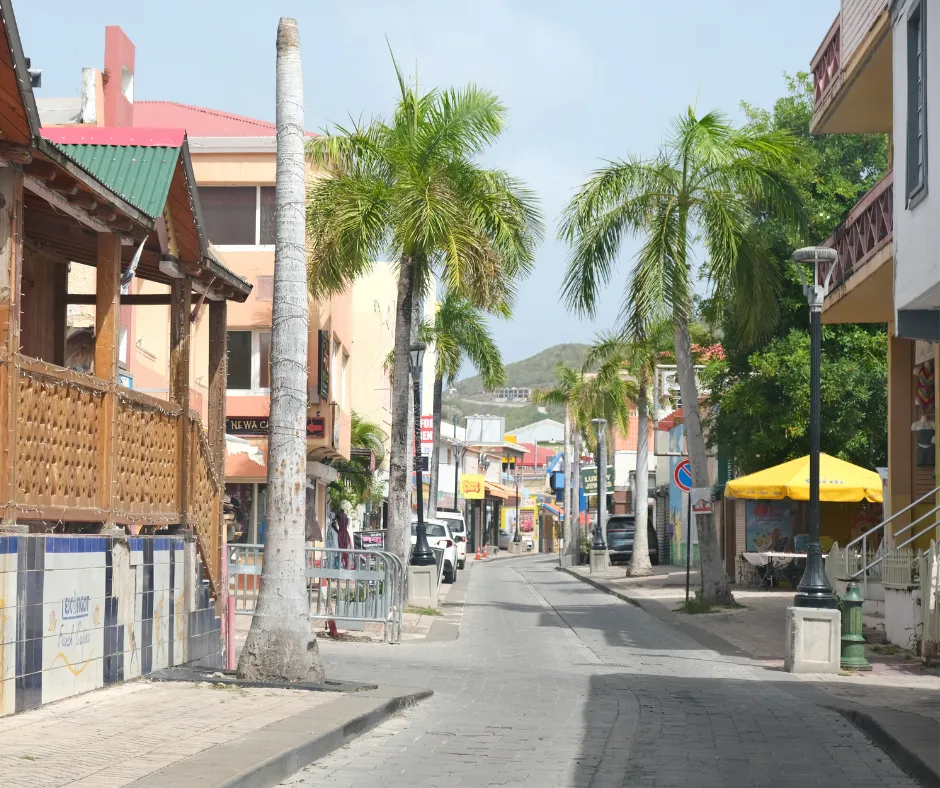
The finish is where the bands come off the road, and the energy at the end of a route is different from the middle: more exhausted, more triumphant, and it runs straight into whatever is happening at the Village afterwards.
If that appeals, Alicia’s Inn is the closest stay to the Jocelyn Arndell Festival Village, roughly a five minute walk on an ordinary day. It sits on Back Street, one block inland, so you will not be watching from your window, but you have the route a short walk one way and the Village a short walk the other. That is the base to pick if you want to catch the bands coming off the road and carry straight on into the Village without negotiating a taxi afterwards.

Take this seriously, because it is the single thing that ruins most first-timers’ parade day.
If the schedule says the parade starts at 11am, do not show up at 11am. Do not show up at 11.30 either. You will be standing in the sun for two hours or more waiting for anything to happen. This is not disorganisation, it is simply how the day runs, and everyone on the island knows it except the visitors.
Our advice: do not arrive before noon. You will still see everything. You will just see it without the two hours of standing around beforehand.
Free: the street parades, the jump-ups, and J’ouvert. You stand on the road and watch, no ticket, no registration.
Some Village events are free as well, and there is usually at least one free family show during the season. Which ones vary year to year, so check the programme when it is published rather than assuming everything at the Village costs money.
Ticketed: most shows, concerts, and pageants at the Jocelyn Arndell Festival Village. Tickets are sold online by individual promoters and at outlets on the island. If you plan to attend several, look into a season pass through the Carnival organisation rather than buying them one at a time.

J’ouvert (pronounced “joo-vay”) kicks off around four in the morning, in the dark, with paint, powder, and mud, and it runs on into daylight. It starts and finishes at the Village, going out and coming back, and the paint and water usually pick up on the return rather than wind down. The messiest part is the end, not the beginning.
Here is the honest thing about spectating J’ouvert: there is barely such a category. There is no clean distance to watch from. Stand anywhere near it and you are getting painted, and nobody will check with you first.
That is not a problem to solve, it is the event itself. The paint is the oldest costume in Carnival, going back to newly freed people covering themselves in the molasses left behind by the plantations, and our guide to what J’ouvert actually is tells that story properly. J’ouvert is also the most open part of Carnival: nothing to buy, no section to join, and visitors are welcome to simply turn up. You only pay if you register with a band, which covers your paint, drinks, and security.
So the real question is not where to stand, it is whether you are in it or not. If you are, wear clothes you will throw away and leave anything you care about at the hotel. Our guide on how to J’ouvert like a pro covers what to wear, what to bring, and how to protect your phone and hair.
If you would rather stay out of it, watch from well back and accept you are seeing it from a distance.

For more on surviving a long Carnival day, see our insider tips for rocking Carnival like a seasoned reveler and our full Carnival packing checklist.
Most of this is common sense, but it is worth saying plainly because visitors get it wrong without meaning to.
Spectators line the edges of the route. The road itself belongs to the bands and the music trucks, and stepping out for a photo puts you in the path of both.
The masqueraders on the road have paid for their place in it. Walking into a section to dance or take photos is the one thing that genuinely annoys people.
Music trucks are big, slow, and the driver cannot see much past the speakers. Keep a real distance from anything moving rather than a polite one, and watch your footing on uneven road.
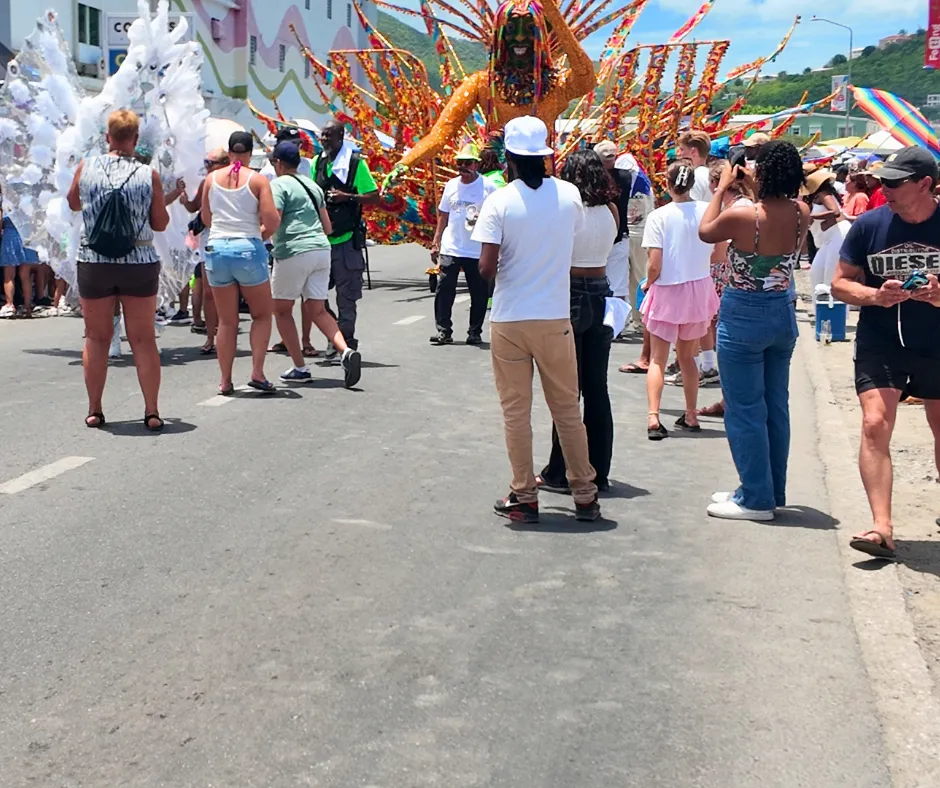
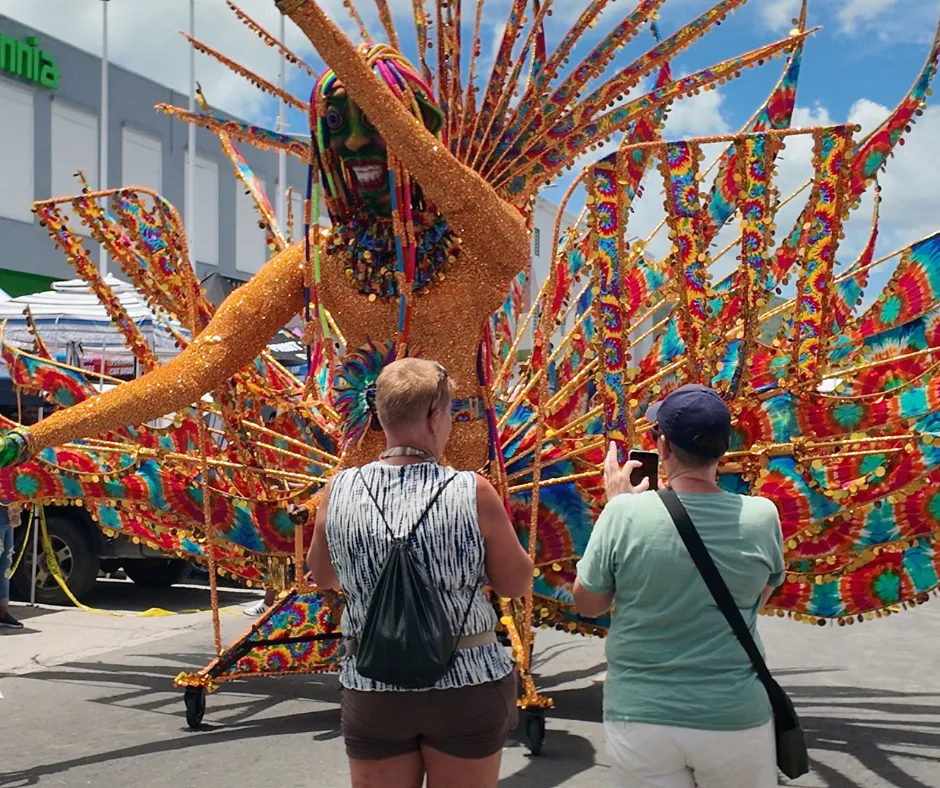
Backpieces and headpieces are fragile, expensive, and often held together more delicately than they look. Ask before photographing someone up close, and accept it if they say no.
Dance where you are standing, respond to the music, wave back. Spectators being into it is part of what makes the road good for the people on it. Being welcoming works both ways.
The road is family territory in St. Maarten and you will see plenty of children on it. A few things worth knowing.
The Pondfill is the easier stretch with kids: more room, space to move, food within reach, and a straightforward exit if someone has had enough. Front Street is narrower and harder to get out of quickly.

The music trucks are genuinely loud. Ear protection for younger children is a sensible call and nobody will think it odd. The same goes for anyone sensitive to loud music or flashing lights at the Village at night.
Agree a meeting point before you head in, and write your phone number on a wristband for younger children in case you get separated. Walk them through where to stand, and why the road stays clear, before the first band reaches you.
The Junior Parade is the properly family-oriented event, and children’s parades across the Caribbean are usually held on separate days from the adult ones. St. Maarten is no exception: it runs weeks ahead of the main parade days rather than alongside them, so a closing-weekend trip will not include it.
J’ouvert is not a children’s event. Four in the morning, paint everywhere, and a crowd that cannot see you coming.
Philipsburg shuts down for the parades. On Grand Parade day the roads through town are closed from the morning through to the end of the day, and anyone not going to the parade is advised to plan a route that avoids the town entirely.
The closures do not all happen at once. They roll along the route in stages as the parade approaches, starting further out and working inwards, so a road that is open when you set off may be shut by the time you reach it.
Watch for the traffic notice. Police publish the traffic measures ahead of each parade, listing the route and the closure points, and the SXM Carnival organisers share the same notice on their social channels. Following them is the easiest way to get the current year’s route and closures instead of working off last year’s.

If you are driving, come early and commit. The one good reason to arrive well ahead of the parade is to park near where you want to watch, on the Pondfill for instance. It works, and it saves you a long walk at the end of the night. Know the trade-off though: once the closures are in place, you are not driving out again until the parade has passed your spot. Turn up late and you get neither, because you will not get into town and you will not find anywhere to leave the car.
Otherwise, plan to walk the last stretch. Once the closures are up, nothing motorised is getting into that section, so expect to be set down outside it and walk in.
On a scooter, stay out of the parade. Police are explicit that scooters and motorcycles must not ride within the parade. Follow whatever officers on duty tell you.
The easiest answer is to stay in Philipsburg. Walk out of your hotel and onto the route, and skip the problem altogether.
Philipsburg is the obvious base for spectators, since both routes pass through Front Street and end at the Village. Staying in town means walking to the road rather than negotiating closures to reach it.
Simpson Bay is the alternative, better for restaurants and nightlife and quieter for sleeping, but you will be taxiing in and out on parade days.
We have gone through this area by area in our local’s guide to where to stay for SXM Carnival.
Use the above map to find and book stays near the Carnival parade route!
There is a lot of island either side of the road days. See our guides on things to do in SXM when you are not at Carnival and day trips and excursions to add to your itinerary.
Worth knowing: the French side runs its own separate Carnival, Carnaval de St. Martin, earlier in the year with its own events and traditions.
Spectating SXM Carnival well comes down to three things: pick the right stretch of road for the day you are watching, do not turn up at the time on the schedule, and bring more water than you think you need.
Get those right and you will have a better day than most people on the road, with none of the costume payments.
Sint Maarten Carnival runs from late April through early May, culminating with the Grand Parade on Labor Day, which marks the official close of the season. In 2027, the carnival runs from Thursday 15 April to Monday 3 May 2027.
Spectators do not need tickets to watch the parades, but playing mas requires registering with a band and purchasing a costume.
Tickets are typically sold online by individual event promoters. On the island, tickets are available at select outlets. Links and ticket outlets are usually shared on SXM Carnival social pages.
Most Carnival activities take place in and around Philipsburg, with nightly events centered at the Jocelyn Arndell Festival Village, which serves as the main hub for shows, competitions, and entertainment during the Carnival season.
Yes — the French side (Saint-Martin) has its own Carnival (Carnaval de St. Martin), held earlier in the year with separate events and traditions.
Yes — Sint Maarten Carnival is very first-timer friendly, with most events happening in central locations, free street parades, and a welcoming atmosphere that makes it easy to join in without prior Carnival experience.
Specials are here!


2 Responses
I will be in Sint Maarten April 10-14. Where can I get individual tickets to the carnival for those days?
For April 10–14, 2026:
April 10 – Opening Jump-Up: No ticket needed for the jump-up itself. Carnival Village entrance fee may apply.
April 11 – Calypso Barbara Junior Calypso & Roadmarch Competition: Tickets at Carnival Village/ entrance fee $25.
April 12 – Carnival Family Fun Day: Carnival Village entrance fee may apply.
April 13 – Culture Night – One Nation, Many Cultures: Carnival Village entrance fee $5.
April 14 – “Unforgettable” – Big Band Culture: Carnival Village entrance fee may apply.