I landed in Malta from Prague and instantly felt the shift. I traded 2–4°C winter chill for 16-degree Mediterranean air and golden limestone buildings that looked straight out of a medieval film set. Walking through Valletta felt cinematic — especially knowing scenes from Game of Thrones were filmed in parts of Malta, including nearby Mdina and Fort Manoel.
Choosing Carnival in Valletta over Cologne or the Caribbean was intentional. I grew up in Caribbean Carnival culture, so I wanted something different — a new tradition without freezing in a bubble jacket. Malta felt like the perfect balance: warm enough to enjoy, culturally rich, and completely new territory.
And then I saw the floats. Massive, detailed, wildly colorful creations that looked like moving art installations. This wasn’t “jump and wave” energy — it was craftsmanship, choreography, and heritage on full display.
But Carnival has a funny way of connecting worlds. In the middle of a dance competition, Beenie Man started blasting through the speakers — an old teenage favorite of mine. Instant goosebumps. That moment summed up Malta Carnival 2026: proudly European, deeply artistic, and unexpectedly nostalgic in all the right ways.
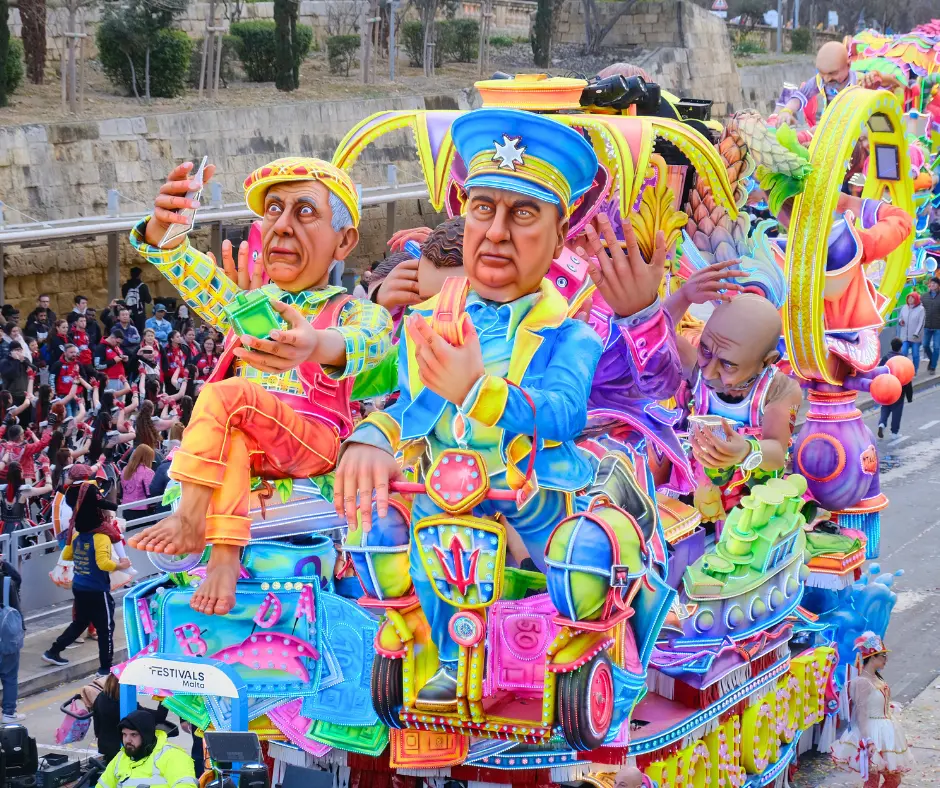

Malta Carnival is a centuries-old tradition that remains one of the island’s most anticipated annual celebrations. What matters most as a visitor is how alive and community-centered it still feels today.
The main events take place in Valletta, where historic streets become a stage for competitive floats, choreographed dance crews, and theatrical presentations. Unlike Caribbean Carnivals built around mas bands and road marches, Malta’s focus is on craftsmanship and performance. It’s structured, artistic, and proudly Maltese — and once you understand that, you experience it very differently.
What I quickly realized is that you can genuinely build your entire day around Carnival in Valletta. There were morning parades, afternoon reenactments, and full evening showcases — whether you’re an early riser or a night owl, there’s always something happening.
The morning parades ran about 2.5 hours and felt like the perfect start to the day. By evening, things doubled in length and intensity, with dance competitions and float presentations stretching on under beautifully lit stages.
My favorite viewing spot was St. George’s Square. Tickets are required, but they don’t oversell, which means everyone has a seat and an unobstructed view — and that matters. The surrounding streets were packed, shoulder-to-shoulder in some areas. If you value comfort and actually seeing the performances clearly, I highly recommend securing tickets for the square, especially for the evening shows.


Musically, most of what I heard seemed local, though a few Caribbean and American tracks made surprise appearances. Unlike Caribbean Carnivals where even spectators are dancing nonstop, Malta felt more performance-focused. People were watching, cheering, and enjoying — not necessarily “jumping.” It created a family-friendly atmosphere that still felt celebratory.
What stood out most were the children. Nearly every child was in costume, which told me this isn’t just for tourists — locals carry the Carnival spirit too. The crowd felt majority Maltese with some obvious visitors mixed in. At one point, I even invited fellow hotel guests to join us after overhearing them talk about the festivities. Carnival has a way of connecting strangers like that.
Malta’s Carnival may not have the “jump and wave” energy I grew up with, but it offers something equally powerful — intentionality, artistry, and a community that truly shows up for its tradition.
I stayed at 66 Saint Paul’s Boutique Hotel in Valletta, and the location alone made the trip smoother. St. George’s Square was just a 5-minute walk away, so I could easily return between programs to freshen up. During Carnival, that convenience is priceless.
The hotel blends historic Maltese limestone with clean, modern finishes — a castle-meets-contemporary aesthetic that mirrors Valletta itself. The room was clean and comfortable, and when I requested different pillows, the staff handled it immediately and kindly.
Breakfast rotated daily (a win for any foodie), and small touches — like chocolates and a Valentine’s Day note left in our room — made the stay feel thoughtful.


For a full breakdown of Valletta vs. Sliema vs. other neighborhoods during Malta Carnival 2027, check out: Where to Stay for Malta Carnival (Plus Neighborhood Breakdown)
Malta became my seafood era.


Living in Prague, I don’t get much fresh seafood, so I leaned in — calamari, seafood linguini, fish and chips, even sushi. Everything tasted fresh and well-seasoned, the kind of meals that remind you you’re on an island.
Beyond seafood, Malta surprised me with its range. We had incredible lamb dumplings at a food court with several Asian options, and later enjoyed Peruvian dishes with bold citrus and spice that felt surprisingly familiar to Caribbean flavors.
Of course, I had to try local pastries. Pastizzi — flaky and savory — were the perfect quick bite, and kannoli satisfied my sweet tooth with their crisp shell and creamy filling. Carnival brought me to Malta, but the food made the experience even richer.
As much as Carnival filled most of our schedule, we carved out time to see Malta from a different perspective — especially from the water.
One of the highlights was a harbor cruise departing from Sliema. Seeing Valletta and the surrounding areas from the sea gives you a completely different appreciation for the island. We passed Manoel Island, Floriana, the Grand Harbour, Marsa, and several other historic points along the coastline. There was an onboard audio guide explaining the sites — though at times it was hilariously hard to follow — which somehow added to the charm. The limestone buildings rising from the water, fortified walls, and layered history felt cinematic and grounding after days in Carnival crowds. Malta may be small, but it is incredibly rich — every turn revealed another fortress, marina, or story.
We also visited the Saluting Battery to witness the traditional cannon firing over the Grand Harbour. Standing there as the cannon went off, with Valletta’s golden architecture behind us, felt like stepping into another century. Even simple walks through Valletta’s narrow streets and colorful balconies added to the experience.
This is why I keep saying Malta Carnival can be more than just Carnival. Between parades and performances, you can cruise the harbor, explore historic landmarks, or simply wander — and that balance is what made this trip feel complete.


Short answer? Yes — I would travel internationally for Malta Carnival again.
Boredom was never an option. The programming was seamless; as soon as one group finished, the next was already in position. While the final day’s activities were unfortunately cancelled due to bad weather, the events that did take place were executed with consistency and strong energy throughout.
Is it enough for a Carnival traveler? Absolutely. My days were so full of parades and performances that I actually needed more time to explore Valletta. If you’re coming strictly for Carnival, your schedule can easily revolve around it. If you prefer a mix of Carnival and sightseeing, Malta makes that balance easy.
That said, if you’re only interested in nonstop soca and road marches, this may not be your vibe. Malta is performance-focused rather than participatory. Carnival in Valletta stands confidently in its own lane. And if you approach it with curiosity instead of comparison, you’ll leave impressed.
Malta Carnival 2026 reminded me that you can travel for Carnival and still experience a destination in full. Sometimes stepping outside of what you know is exactly what makes the experience unforgettable.
Malta Carnival 2027 will take place from February 5 to February 9, 2027. The main parades and biggest celebrations happen over the final weekend through to Fat Tuesday.
The main celebrations are in Valletta and Floriana, but Carnival activities happen across Malta and on the island of Gozo.
Street parades and public celebrations are free, but certain performances — like seated viewing in St. George’s Square — require tickets.
It typically runs for five days before Lent, with different programs scheduled throughout each day.
Expect elaborate floats, choreographed dance troupes, masked costumes, and music filling the streets of Valletta and Floriana.
Yes — in Nadur on Gozo, the “Spontaneous Carnival” is more free-form and less structured than the official Valletta events.
Traditional treats include perlini (sugar-coated almonds) and prinjolata, a layered dessert typically enjoyed during Carnival season.
Absolutely — the structured schedule allows visitors to experience multiple parades and performances even on a short trip.